
iCAB/RPV Protocol Toolkit
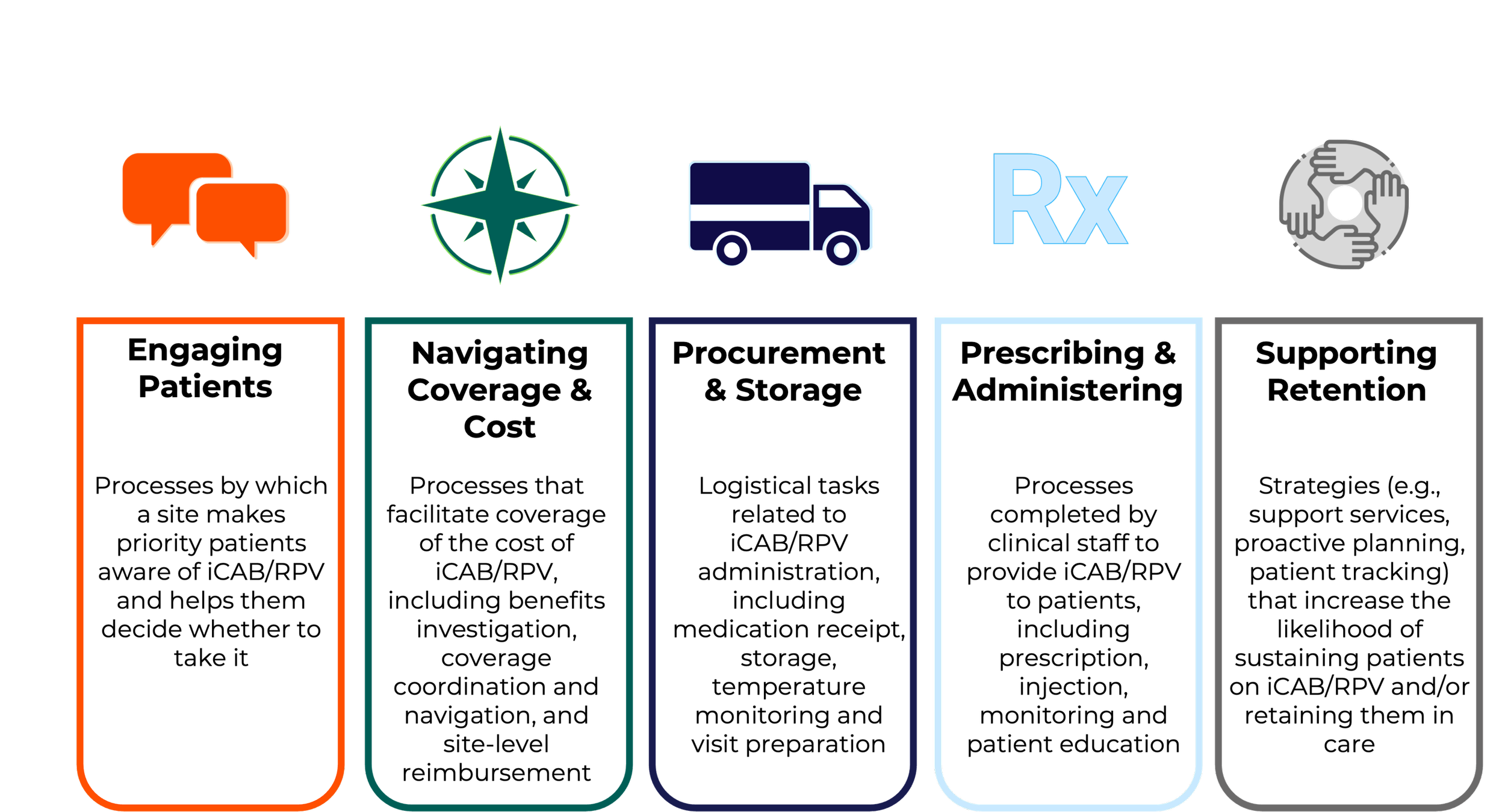
Learn about the five programmatic building blocks!
Review each overview, then complete the accompanying worksheets and template to support the development of a cohesive clinical and programmatic iCAB/RPV protocol.


Engaging Patients
Engaging Patients refers to how your site makes patients aware of iCAB/RPV and supports them in deciding if it’s right for them. This includes raising awareness, educating priority patients about starting and maintaining treatment, and offering shared decision-making counseling. Engagement may also involve providing wrap-around support to increase access and sustainability.
- Educating patients about the availability of iCAB/RPV at the site and ensuring general awareness of it as a treatment option.
- Assessing patient fit and eligibility based on medical criteria, willingness to consider injections, logistical needs, and insurance/financial considerations.
- Providing shared decision-making counseling to help patients evaluate whether iCAB/RPV aligns with their physical, emotional, social, and financial needs.
- Offering wrap-around supports (e.g., navigation, reminders, financial assistance pathways, transportation) to increase access, adherence, and sustainability.
- Establishing clear engagement protocols that guide which patients are prioritized, how staff communicate about iCAB/RPV, and how engagement steps are documented.
Navigating Cost & Coverage
Navigating Coverage and Cost refers to the processes your site uses to help patients access iCAB/RPV and manage the financial aspects of care. This includes investigating coverage, coordinating benefits and prior authorizations, connecting patients to financial assistance, reducing out-of-pocket costs, and ensuring appropriate reimbursement for medication and related services.
- Investigating patient coverage, such as reviewing insurance benefits, confirming medical or pharmacy benefit pathways, and identifying eligibility gaps.
- Coordinating coverage requirements, including prior authorizations, communication among pharmacy/payer/clinic, processing denials and appeals, and facilitating enrollment in assistance programs.
- Educating patients about cost and coverage, providing transparent information on expected expenses, financial supports, and how coverage affects both initiation and sustainment.
- Identifying and securing resources to reduce out-of-pocket costs, such as patient assistance programs, savings programs, or alternative sites of administration that improve affordability and access.
- Ensuring appropriate reimbursement for medication (if applicable), administration visits, and lab services, including verification before each injection and reauthorization as needed.
Procurement & Storage
Procurement and Storage refers to the logistical processes that ensure iCAB/RPV is safely obtained, stored, and prepared for administration. These activities support timely, coordinated visits and maintain the medication, from ordering and receiving shipments to temperature monitoring and preparing doses for injection.
- Obtaining medication from an authorized distributor or specialty pharmacy and tracking shipments for patient-specific or stock supply.
- Managing receipt and storage, including cold-chain requirements, refrigerator monitoring, and documentation.
- Preparing medication for administration, such as bringing vials to room temperature within safe time limits and handling filled syringes appropriately.
- Coordinating timing with patient visits to ensure medication is on-site and ready while minimizing waste from missed appointments.
- Maintaining additional supplies and tools, including needles, emergency kits, and documentation systems for procurement, storage, and waste tracking.
Prescribing & Administering
Prescribing and Administering refers to the clinical processes by which staff provide iCAB/RPV to patients, from determining eligibility to delivering each injection. This includes reviewing clinical considerations with the patient, writing prescriptions that meet coverage and dosing needs, safely administering injections, and educating patients on side effects and managing missed doses. Coordination across the care team ensures medication is available, prepared correctly, and that visits support a positive patient experience and sustained iCAB/RPV use.
- Reviewing clinical considerations, engaging in shared decision-making with the patient, and developing a retention plan.
- Writing prescriptions for iCAB/RPV, including determining oral lead-in use, dosing interval (monthly, bi-monthly, every eight weeks), and ensuring coverage requirements are met.
- Administering iCAB/RPV injections safely, with attention to correct technique and needle selection to ensure effective viral suppression.
- Educating patients about side effects, how to manage them, and the importance of injection visit attendance, including guidance on oral bridge medication for missed or delayed injections.
- Coordinating with the care team to ensure medication availability, room temperature preparation, and overall patient-centered care during injection visits.
Supporting Retention
Supporting Retention refers to strategies that help patients stay engaged in care and maintain consistent use of iCAB/RPV or oral ART if injections are missed or discontinued. These strategies focus on patient-centered support, proactive planning, and coordination across the care team to optimize adherence and health outcomes.
- Providing supportive services to help patients sustain engagement in iCAB/RPV and broader HIV care.
- Conducting regular check-ins before and after injection visits to reinforce adherence and address barriers.
- Coordinating oral bridge medication or transitioning patients back to oral ART when injections are missed or discontinued.
- Developing proactive contingency plans for missed visits, patient relocation, or other disruptions in care.
- Tracking patients, following up on appointments, and facilitating communication among the care team to ensure continuity of care.